
THE 5 LEADERSHIP FORMATION STAGES

When a Self-Actualization Quest Becomes Most Useful
When we study the lives of great leaders across history, a striking truth emerges: their growth was never random. The arc of their self-actualization follows a recognizable pattern—a structure as real as the stages of a child’s development, or the seasons of a tree.
Human potential does not unfold by accident.
Leadership formation has its own ordered rhythm, its own predictable sequence. Researchers have observed it. Sages have taught it. And when you see it clearly, it becomes a map for your own journey.
Without a map, it is easy to feel lost—stuck in confusion, mistaking a temporary struggle for a permanent flaw.
But with a map, you can locate yourself: see the strengths of your current stage, understand the challenges that hold you back, and glimpse the next stage pressing to emerge. That awareness alone can transform your perspective.
This is precisely where a Self-Actualization Quest becomes most powerful.
It is not just a retreat. It is the decisive process that carries you from one stage of growth to the next, breaking old patterns and opening new possibilities. To apply it well, you must begin by asking: Where am I now? What is this stage calling me to learn? And what must I release to step forward?
To answer, we will look at the five stages of leadership formation through the metaphor of a tree.
For leadership, like nature itself, follows a living order of growth. It is no accident that the wisest teachers across history have pointed to plants and trees to explain the unfolding of life, character, and destiny.
Stage 1: Latent Leadership – The Seed


The word latent means a quality that exists within, but is not yet developed or manifest. It is potential concealed – like the seed of a tree.
Every tree, from the smallest sapling to the towering California Redwood, begins with such a seed. The redwood, which can grow over 115 metres high – taller than a 35-story building – starts from a speck barely 3mm in length.
And yet, that seed carries everything it needs: the DNA code, the latent energy, and the blueprint to grow into majesty.
Leadership begins in the same way. At this first stage, the work is to uncover your own DNA strand as a leader: your strengths, interests, ideas, and the formative experiences that have shaped you.
These are not incidental—they are the raw material of your destiny. Greatness does not emerge in spite of your story, but precisely because of it. Leaders learn to embrace and elevate their unique history into a higher order, a vision that is distinctly their own.
But potential alone is not enough. Just as a seed depends on soil, climate, and environment, so too does latent leadership.
Most seeds never grow into trees—not because their DNA is flawed, but because their environment does not allow flourishing. Many with leadership potential remain undeveloped for the same reason: they settle into the wrong soil.
Here lies the first challenge—and the first place where many become stuck. To grow, you must answer two questions:
- What is my true calling as a leader?
- What environment will best allow me to flourish?
This is where a Self-Actualization Quest is invaluable.
Properly designed, it activates the processes that reveal both your calling and the conditions for your growth. Sometimes this comes through chance encounters or moments of intuition. But a Quest makes it intentional, deliberate, and decisive.
This stage ends only when a leader chooses a path—when they respond to their calling.
With that decision, the seed cracks open, and the sprout begins to grow.


Stage 2: Self-Leadership – The Sprout

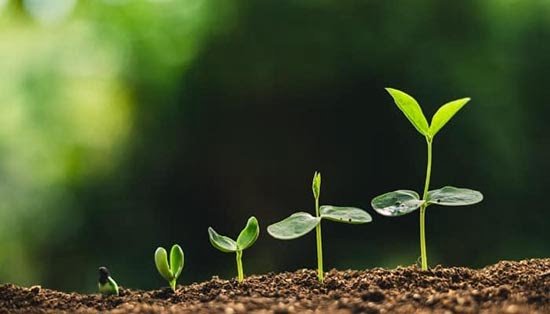
When conditions are right, the seed germinates. The shell breaks, the embryo awakens, and a sprout emerges.
One part pushes down into the soil, anchoring itself in nutrients and water. The other pushes upward, searching for light. Without that light, the sprout cannot live.
Kahlil Gibran captured this stage with poetic precision:
“You are good when you strive to give of yourself.
Yet you are not evil when you seek gain for yourself.
For when you strive for gain you are but a root that clings to the earth and sucks at her breast.
Surely the fruit cannot say to the root, ‘Be like me, ripe and full and ever giving of your abundance.’
For to the fruit giving is a need, as receiving is a need to the root.”
In leadership, this stage corresponds to training and formation – the period where you learn how to fulfill your calling. It may take the form of academic or technical study, direct hands-on experience, or apprenticeship under those already in the field. Whatever the method, the essence is the same: developing your “root and shoot” system.
Roots represent your ability to draw sustenance—to cultivate knowledge, skills, and attitudes that ground you. Shoots represent your upward striving – the drive to test yourself, to reach for vision, and to begin serving others. Both are necessary.
This is the stage of self-leadership. You must learn how to discern what is worth pursuing (doing the right things) and how to manage yourself so you can act effectively (doing things right).
Here, you demonstrate – first to yourself – that you have what it takes to stand on your own feet as a leader.
But many get stuck here. The traps are familiar: lack of clarity about who you are called to serve, inability to execute with consistency, or wavering confidence in your own ability to deliver. Without clear light – clarity of direction and conviction of purpose—the sprout cannot grow.
The key questions of this stage are:
- Where should I focus my gifts, skills, and efforts to make a real difference?
- Who is my tribe—the people I am called to serve?
- And can I trust myself to deliver with integrity?
This is where a Self-Actualization Quest becomes decisive. Properly designed, it helps you answer these questions, establish your root system, and reach toward the light. It grounds your ideas in the right environment, at the right time, for the right reasons.
Without this light, growth halts. With it, you are ready to move toward the next stage of leadership formation.


Stage 3: Probationary Leadership – The Seedling

 As the seedling emerges, it begins to grow leaves. The leaves capture light and, through photosynthesis, generate the energy needed for growth.
What was once a fragile sprout now starts to resemble a young tree, as its soft green stem hardens into bark.
But this is also the stage of greatest vulnerability.
The seedling must now compete with other plants for water, light, and nutrients, while resisting threats from frost, floods, insects, and grazing animals. Many seedlings never survive this stage.
In leadership, this is the probationary stage.
You step into a real platform of influence – tentative, limited, and on trial. Here, the training of Stage 2 begins to bear fruit. You apply your knowledge and skills in practice. You discover your influence on others, and from that impact, you draw the energy to keep growing.
This is where you experiment with your unique strengths and style. Some efforts succeed, others fail. You learn quickly through direct feedback. You begin to shed your greenness: real relationships with those you lead reveal both your opportunities and your shortcomings.
Like a seedling in a crowded forest, you also become aware of the wider ecology of leadership—other voices competing for influence and authority. This is both daunting and clarifying.

Most aspiring leaders get stuck here. Frustrated that their output does not match their vision, many give up.
They do not realize that this stage is not about productivity, but about recognition: discovering what makes you distinct. Your task is to identify your signature strengths and your authentic voice as a leader.
The critical questions of this stage are:
- What is my unique voice as a leader?
- What strengths, when applied, make a measurable difference for those I serve?
The wise leader, like an artist, resists the trap of comparison. Instead of imitating others, they refine their own voice and craft their own style.
A Self-Actualization Quest at this stage helps you make this turn. It clarifies your unique contribution and fine-tunes your strategic advantage – so that instead of competing for space, you grow into the place only you can occupy.

Stage 4: Productive Leadership – The Sapling
As the young tree grows into a sapling, it develops a strong vegetative crown – branches and leafstalks spreading wide to sustain its life. This is a formative stage: the structural blueprint of the mature tree is being set.
To reach this form, the sapling must endure repeated cycles of spring, summer, autumn, and winter.
It is not yet old enough to reproduce, but it is in its most productive growth phase – absorbing, expanding, and establishing the framework for its full stature. In human terms, this is adolescence: the years of rapid development, where energy surges, mistakes are made, and identity begins to take shape.
In leadership, this is the stage where a person begins to effectively exert their strengths upon their calling.
The preparation of the earlier stages now consolidates into focus and momentum. A leader at this stage experiences deep fulfillment from contribution, because their work finally aligns with their strengths and gifts.

Crucially, this stage demands discipline of priority. The leader learns that not every opportunity is worth pursuing. Saying “no” to distractions is as important as saying “yes” to the mission. The sapling, like the leader, must direct its energy upward, not scatter it sideways.
This is why Stage 4 is often the most productive phase of leadership development.
There is a growing maturity, a confidence in one’s role, and a sense of control. Yet the challenge here is not capacity – it is focus. Many leaders exhaust themselves by chasing every emergent possibility, instead of mastering the few things that matter most.
The character of leadership also matures here. The leader realises that influence flows not from appearances, image, or competition – but from integrity and depth of being. True productivity emerges when who you are and what you do are aligned. This maturity attracts the right collaborators, co-creators, and audience around the mission.
Yet the central challenge of this level is not simply to be busy or efficient, but to become effectively fruitful. The key questions become:
- How can I generate the greatest good, with the least wasted effort, for the greatest number of people?
Supportive questions for this stage are:
- Am I focusing my energy on what is most aligned with my strengths and mission?
- Do I have the discipline to say “no” so I can deliver at my best?
This is the shift from efficiency (doing things right) to effectiveness (doing the right things). The leader at this stage is called to simplify, to align strengths with opportunity, and to structure their efforts for maximum impact.
A Self-Actualization Quest at this stage is uniquely powerful.
By stepping away from the demands of everyday productivity, leaders gain clarity on what matters most. The Quest helps them discern where their unique gifts best meet the world’s deepest needs – so they can return with renewed conviction, sharpened focus, and a strategy for multiplying their influence without burning out.
This stage is where leaders learn to move from activity to fruitfulness – laying the foundation for the next great movement in leadership formation.

Stage 5: Synergic Leadership – The Mature Tree

In its mature phase, the tree transforms into something solid and enduring. Its stems and branches harden into wood, its bark thickens into a protective shield, and its reproductive structures come into full expression. Flowers bloom, fruit appears, seeds disperse—and the cycle of life continues beyond the tree’s own span.
At this stage, the tree’s growth has reached its natural limits. Its greatest challenges are no longer internal but external—resisting storms, pests, disease, or competition from stronger species. Its task is to stand firm, bear fruit, and ensure continuity through reproduction.
So it is with the leader. This final stage is synergic leadership: the integration of a mature character, a refined leadership style, and a mission lived in harmony with both inner strengths and outer community.
Here, the leader embodies the wisdom that true power comes not from control but from synergy—where the whole becomes greater than the sum of its parts.

This is leadership at its peak. The leader’s influence radiates outward, often beyond the original field of work or interest, weaving into networks and causes previously unimagined.
Their fruit is undeniable, and the impact of their life multiplies far beyond what they could have achieved alone.
The challenge of this stage is no longer proving one’s capacity but ensuring one’s legacy. The pressing questions are:
- How will the vision I’ve cultivated continue after me?
- How can I invest in successors who will carry this mission further?
- What must I do to ensure my life’s work remains relevant and fruitful beyond my own years?
A Self-Actualization Quest at this level clarifies succession. It provides the leader with the space to step back, align with transcendent purpose, and discern how best to sow into the next generation.

The Five Stages in Summary
Stage 1: Latent Leadership – The Seed
The challenge of discovering your unique DNA, your calling, mission, and gifts.
Stage 2: Self-Leadership – The Sprout
The challenge of learning to lead yourself—where to focus, who to serve, and why.
Stage 3: Probationary Leadership – The Seedling
The challenge of finding your voice and refining your strengths through practice.
Stage 4: Productive Leadership – The Sapling
The challenge of effective production—aligning strengths with opportunity for maximum fruitfulness.
Stage 5: Synergic Leadership – The Mature Tree
The challenge of succession—ensuring the mission outlives the leader.
Where Are You on This Journey?
Each of us moves through these stages, sometimes in-between, sometimes wrestling with one more than another. But the question is:
Where are you now?
And which challenge is calling for your attention?
If you resonate with any of these stages, yet lack the clarity or confidence to step into the next, then a Self-Actualization Quest may be exactly what you need.
Our role is simple: to guide you with the very best processes available so you can arrive at your own answer with conviction.
Here’s how to begin:
1. Book your free Fast Track Call and select the best date and time. (see below)
2. Complete a brief self-assessment and send it back to us.
3. Watch our complimentary documentary screening, then join us on Zoom at the agreed time.
If this resonates with you, and you are ready, the five-phase Self-Actualization Quest Counselling Experience awaits.
